

Radiotherapy Reprograms Immune Response in Rare Skin Cancer

A new Northwestern Medicine study has discovered how radiotherapy alters the immune environment within cutaneous T-cell lymphoma (CTCL) tumors, according to findings published in the Journal of the American Academy of Dermatology.
The study reveals how radiotherapy not only eliminates cancer cells but also reprograms the surrounding tumor microenvironment, revealing new molecular signatures associated with long-term treatment response and tumor recurrence.
“Our findings show that radiation does much more than kill lymphoma cells; it fundamentally reshapes the immune ecosystem surrounding the tumor,” said co-senior author Alan Zhou, MD, ‘21 MSc, associate professor of Dermatology and chief of the Division of Medical Dermatology. “Understanding these immune changes may help us predict which patients will have durable responses and identify new therapeutic strategies that enhance the long-term effectiveness of radiation.”
Cutaneous T-cell lymphoma (CTCL) is a rare type of lymphoma — a cancer affecting lymphocytes — that mainly affects the skin and is most commonly diagnosed in people over the age of 50.
Radiotherapy is one of the most effective treatments for CTCL. However, while many tumors remain in remission after treatment, others will recur despite initially responding to treatment.
To better understand the molecular effects of radiotherapy in CTCL tumors, the scientists studied paired skin biopsy samples and non-invasive skin tape-strip samples collected both before and after radiotherapy from patients with CTCL.
They then used spatial transcriptomics and high-dimensional proteomics techniques to characterize gene expression within the tumor microenvironment while also measuring proteins released from the skin.
The novel skin-tape approach involves applying a round piece of specialized tape onto a person’s lesional tumors multiple times where it is then able to capture proteins biomarkers expressed on the surface of the skin.
“This is the first study to show that we can use painless tape strips to track disease-related protein biomarkers in cutaneous lymphoma over the course of treatment,” Zhou said. “That could one day make it much easier to monitor patients and personalize their care.”
By analyzing these samples, the scientists found that before radiotherapy, the tumors exhibited molecular hallmarks of CTCL including inflammatory signaling, exhausted T-cells and macrophages promoting tumor growth.
After radiotherapy, however, they found the immune landscape in the tumors changed significantly, including decreased tumor-associated inflammatory pathways, increased wound-healing programs and innate immune activation. Unexpectedly, the investigators also observed in these tumors the activation of humoral immune pathways involving antibody-producing immune cells.
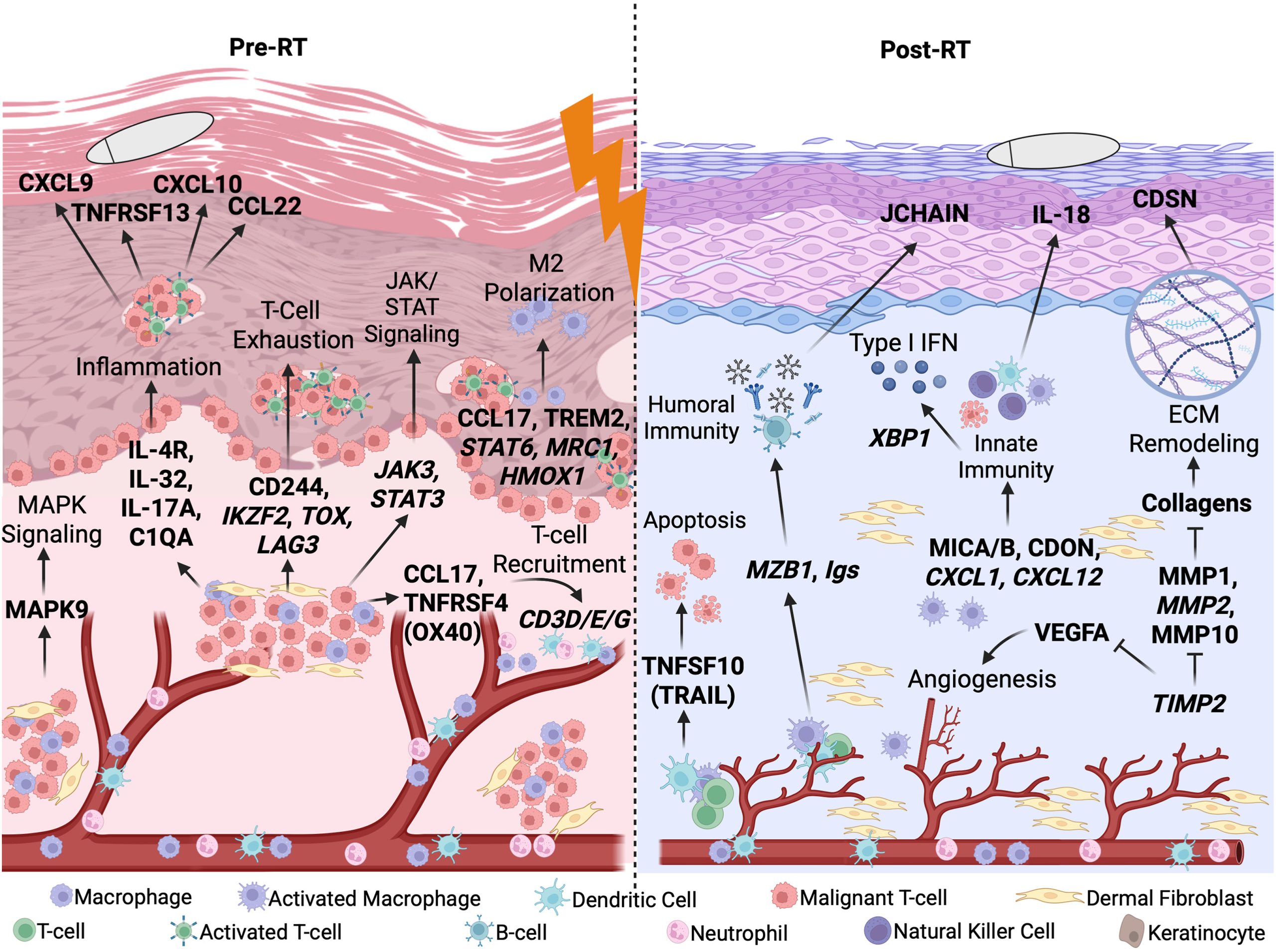
“These results suggest that antibody-mediated immunity may play a much larger role in anti-tumor responses than previously appreciated,” said Zhou, who is also a member of the Robert H. Lurie Comprehensive Cancer Center of Northwestern University.
They also observed molecular differences between patients whose tumors remained in remission and those whose tumors recurred within one year of treatment. Tumors that recurred demonstrated increased expression of genes associated with radiation resistance and persistent inflammation, while tumors that remained in remission exhibited stronger interferon signaling and sustained humoral immune activation following radiotherapy.
The findings suggest that these molecular biomarkers could help identify CTCL tumors at greater risk of recurrence earlier, according to Zhou.
The study also demonstrates the feasibility of using non-invasive skin tape strips for monitoring longitudinal molecular changes within a tumor, allowing patients to be observed over time without having to undergo repeated skin biopsies, Zhou added.

“Patients with cutaneous lymphoma often undergo multiple biopsies throughout the course of their disease,” Zhou said. “Our findings suggest that non-invasive tape strips may provide a practical way to repeatedly monitor disease-relevant biomarkers over time. We envision a future where we can combine molecular profiling of tumors with simple skin sampling to personalize treatment decisions and track how patients are responding.”
Zhou said the current study opens new opportunities to develop combination therapies that enhance anti-tumor immunity while bringing precision medicine closer to routine clinical care.
Ziyou Ren, ‘20 PhD, assistant professor of Dermatology and of Preventive Medicine in the Division of Epidemiology, was co-senior author of the study.
JoJo Holm, a clinical research coordinator in the Department of Dermatology; Eleanor Ostroff, a clinical research fellow in the Department of Dermatology; and Lauren Clarke, ‘25 MD, were co-lead authors of the study.
Co-authors include Katherine De Jong; Yanzhen Pang, MD, a postdoctoral fellow in the Department of Dermatology; Madeline Hooper, MD, a resident physician in the Department of Dermatology; Spencer Evans; Kurt Lu, MD, the Eugene and Gloria Bauer Professor of Dermatology; Stephanie Rangel, ‘14 PhD, associate professor of Dermatology; Bharat Mittal, MD, ‘80 GME, professor of Radiation Oncology; Joan Guitart, MD, chief of Dermatopathology in the Department of Dermatology; and Ralph Weichselbaum, MD, chair of the Department of Radiation and Cellular Oncology at the University of Chicago.
The study was supported by the Dermatology Foundation, Cutaneous Lymphoma Foundation, American Cancer Society, Lymphoma Research Foundation, Gilead Research Scholars Program and philanthropic support from private donors.
Legal Disclaimer:
EIN Presswire provides this news content "as is" without warranty of any kind. We do not accept any responsibility or liability for the accuracy, content, images, videos, licenses, completeness, legality, or reliability of the information contained in this article. If you have any complaints or copyright issues related to this article, kindly contact the author above.
